
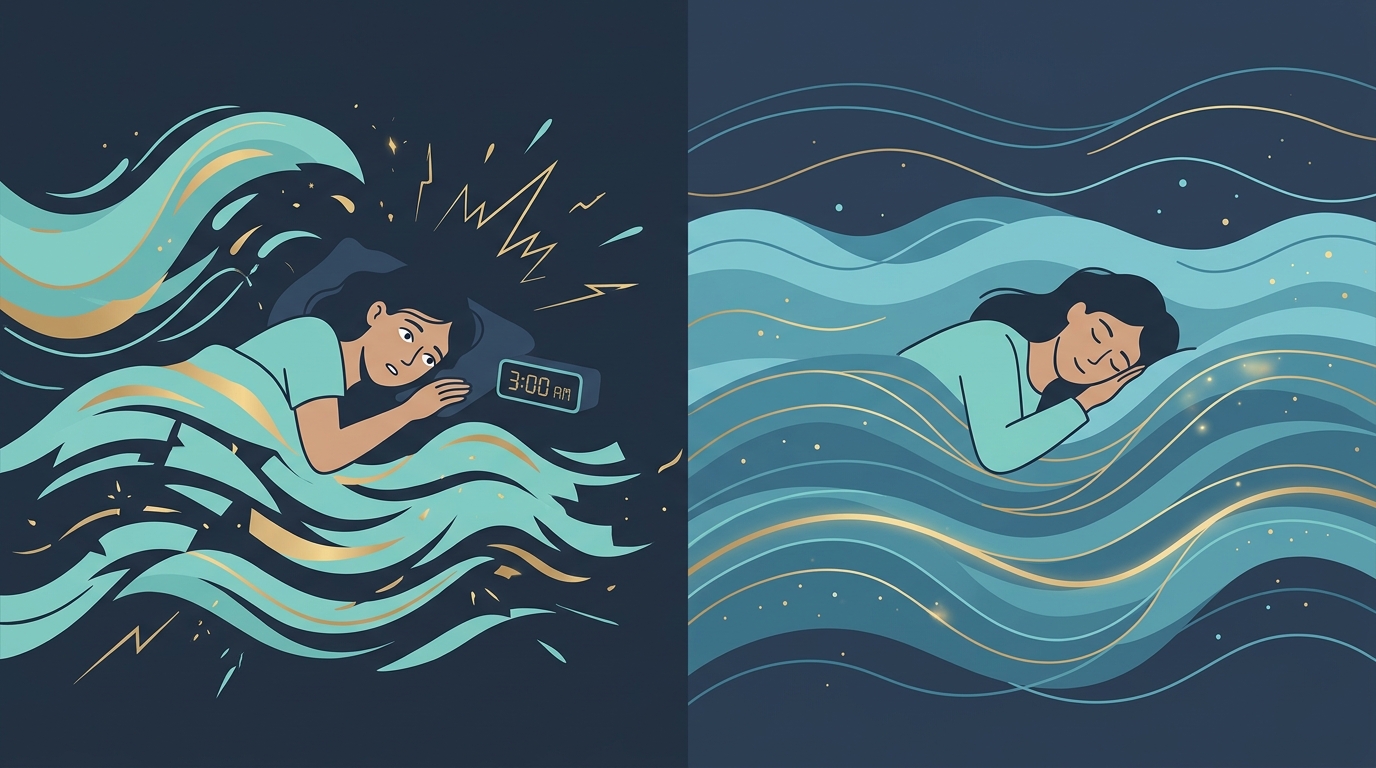
You've probably noticed it: a couple of glasses of wine and you're out cold within minutes. It feels like alcohol is the perfect sleep aid. But somewhere around 2 or 3am, you're wide awake, heart beating slightly too fast, staring at the ceiling. What's going on?
The relationship between alcohol and sleep is one of the most misunderstood in health. Alcohol doesn't help you sleep. It sedates you — which is not the same thing. And the distinction matters enormously for how you feel the next day, and the day after that.
What Alcohol Actually Does to Your Brain at Night
Sleep happens in cycles — roughly 90 minutes each, cycling through light sleep, deep sleep (slow-wave sleep), and REM (rapid eye movement) sleep. Each stage plays a specific role in physical and mental recovery. Alcohol disrupts this architecture in a predictable pattern:
First Half of the Night: The False Win
In the first few hours after drinking, alcohol increases slow-wave sleep (the deep, restorative stage) and suppresses REM sleep. This is why you feel like you slept well at first — you got more deep sleep than usual. But this phase comes with a cost that arrives later.
Second Half of the Night: The Rebound
As your liver metabolizes the alcohol, something called REM rebound occurs. Your brain, deprived of REM sleep in the first half of the night, now tries to make up for it with an intense surge of REM activity. This produces vivid, often disturbing dreams, lighter sleep, and frequent waking — typically 3–5 hours after you fell asleep, right in the middle of the night.
The Dehydration Factor
Alcohol is a diuretic, meaning it causes your kidneys to produce more urine. You lose more fluid than you take in, even when drinking beer or wine. By the middle of the night, mild dehydration activates your body's stress response, raises cortisol, and makes it much harder to fall back asleep once you wake.
The Adenosine Effect
Alcohol increases adenosine — the chemical that builds up throughout the day and drives sleep pressure. This is part of why it makes you drowsy. But adenosine clears faster than alcohol metabolizes, so a few hours later your sleep pressure drops while you still have alcohol in your system, leaving you in an awkward zone of physiological alertness that feels like anxious wakefulness.
The Numbers: How Much Does Alcohol Hurt Sleep?
Research published in JMIR Mental Health found that alcohol consumption reduces overall sleep quality by 39.2% — even when it doesn't reduce total sleep time. Other findings include:
- Even one drink measurably reduces REM sleep in the second half of the night
- Two to three drinks reduce overall sleep quality by approximately 24%
- More than three drinks can reduce sleep quality by up to 39%
- People who drink regularly show suppressed deep sleep even on nights they don't drink, as the brain adapts to expect alcohol
- It takes an average of 4–7 alcohol-free nights for sleep architecture to normalize after a period of regular drinking
The Sleep-Anxiety Feedback Loop
Here's where it gets insidious. Poor sleep increases anxiety. Anxiety often drives people to drink "to take the edge off." Alcohol temporarily relieves anxiety but further degrades sleep, which increases baseline anxiety levels over time. You end up drinking more to manage a problem that drinking is causing.
This cycle is one of the most common patterns among people who describe themselves as "social drinkers" — not alcoholics, not problem drinkers, just people who have gradually normalized using alcohol as a sleep and anxiety aid.
The Hangxiety Explained
That anxious, jittery feeling the morning after drinking has a name: hangxiety. It's caused by your brain overcompensating for the GABA boost alcohol provides. As alcohol clears your system, GABA activity drops below baseline, temporarily increasing anxiety and stress sensitivity. Poor sleep makes it worse.
"But I Sleep Fine After Drinking"
This is one of the most common objections — and it's worth taking seriously. Many people genuinely feel like they sleep well after drinking. There are a few reasons this perception is often wrong:
- You're sedated, not sleeping deeply. The unconsciousness feels like rest, but the restorative stages are being shortchanged.
- You've adapted. Regular drinkers often develop tolerance to alcohol's sleep-disrupting effects — meaning they need more alcohol to get the same sedation, and their baseline sleep quality has gradually declined without them noticing.
- Confirmation bias. You remember the nights you felt okay. You don't track the subtle fog, the slower thinking, or the mood dip that accumulated over weeks of poor sleep.
This is exactly where tracking becomes powerful. When you log your drinks and note your sleep quality the following morning, patterns emerge over days and weeks that are invisible in the moment. "I feel fine" becomes "I consistently feel worse after more than two drinks" once you have the data.
How Long Until Sleep Improves After Quitting or Reducing?
The good news: sleep is one of the fastest-improving metrics when you reduce alcohol. Many people report measurable differences within the first week. Here's a general timeline:
- Days 1–3: Sleep may actually feel worse as your brain rebounds from alcohol suppression. Vivid dreams and lighter sleep are common.
- Days 4–7: REM sleep begins to normalize. Dreams remain vivid but feel less disturbing. You start waking less in the night.
- Weeks 2–4: Deep sleep and REM cycles stabilize. Most people report significantly better morning energy and clearer thinking.
- Month 2+: Baseline anxiety drops as sleep quality compounds. The virtuous cycle — better sleep → less anxiety → less need to drink → better sleep — takes hold.
Practical Steps to Better Sleep Starting Tonight
- Set a cutoff time. Try stopping alcohol at least 3 hours before bed. The earlier the better — alcohol metabolizes at roughly one standard drink per hour.
- Track the connection. Log your drinks and rate your sleep the next morning. Two weeks of data will show you your personal threshold more clearly than any study.
- Replace the evening ritual. If a glass of wine is your "wind-down" signal, find a replacement that serves the same function — herbal tea, a walk, a non-alcoholic drink you actually enjoy.
- Expect the first few nights to be rough if you've been drinking regularly. Your brain needs time to recalibrate. Push through the first week.
- Measure the results. Note how you feel on mornings after alcohol-free nights vs. drinking nights. The difference becomes your motivation.
Track the Alcohol–Sleep Connection for Yourself
Remedy lets you log your drinks and track how you feel the next day — so you can see your own patterns and make informed choices.


The Bottom Line
Alcohol is not a sleep aid. It's a sedative that borrows from your sleep quality and charges compound interest. The faster you fall asleep, the worse you may actually be sleeping — and the harder it becomes to sleep without it over time.
The single most consistent finding among people who track their drinking is this: their sleep improves faster than almost anything else. It's often the first change they notice, and it's often the one that motivates everything else.